Asbestos Exposure: Military, Secondary & How to Prove Your Claim
- Asbestos was used in thousands of products across dozens of industries throughout the 20th century
- Shipyard workers, construction workers, and military veterans face the highest lifetime exposure risk
- Secondhand (take-home) exposure has caused mesothelioma in family members of workers
- Companies knew asbestos was dangerous for decades before warning their workers
- Victims can pursue compensation through lawsuits and asbestos trust fund claims
A Brief History of Asbestos Use in the United States
Asbestos is a naturally occurring mineral that was prized for centuries for its heat resistance and durability. By the late 19th century, U.S. manufacturers had discovered that asbestos could be woven into fabric, mixed into building materials, and used as insulation in industrial applications. Production skyrocketed during the early 20th century, and by World War II, asbestos was used in virtually every naval vessel, power plant, and industrial facility in the country.
What makes the history of asbestos so troubling is that the hazards were known — and hidden. Internal documents from asbestos manufacturers dating to the 1930s show that company executives knew their products caused serious lung disease. Rather than warn workers or the public, many companies suppressed research, lobbied against regulation, and continued selling their products. It wasn't until the 1970s and 1980s that meaningful federal restrictions on asbestos began to take effect — by which time millions of American workers had already been exposed.
High-Risk Industries and Occupations
While asbestos was used in countless settings, certain industries saw the highest concentrations of exposure. If you or a loved one worked in any of the following fields, there is an elevated risk of asbestos-related disease:
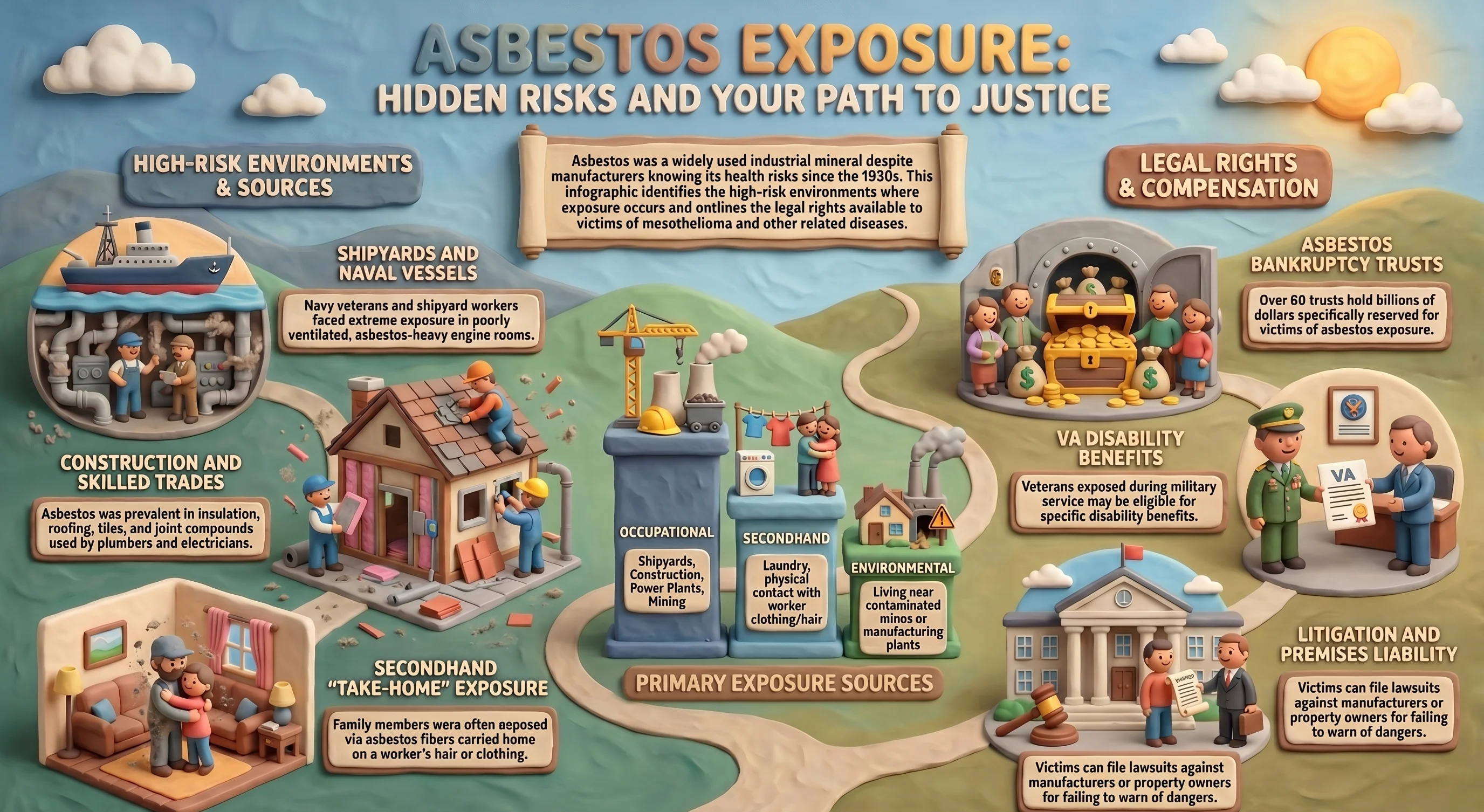
Shipbuilding and Naval Service: The U.S. Navy used asbestos extensively in ships — in boilers, steam pipes, turbines, valves, pumps, and sleeping quarters. Shipyard workers who built, repaired, or overhauled vessels were exposed to extraordinarily high concentrations of asbestos fibers, sometimes for many years. Veterans who served aboard ships — especially those built before 1980 — may have been exposed to disturbed asbestos in confined spaces with poor ventilation.
Construction and Skilled Trades: For decades, asbestos was used in roofing shingles, floor tiles, ceiling tiles, joint compound, textured paint, pipe insulation, and spray-on fireproofing. Construction workers, plumbers, electricians, carpenters, and drywall finishers were among those most regularly exposed. Demolition and renovation workers may still face exposure today when working with older buildings that contain intact asbestos materials.
Industrial and Manufacturing: Steel mills, power plants, chemical plants, and oil refineries used large quantities of asbestos insulation on pipes, boilers, and furnaces. Boilermakers, pipefitters, insulators, and millwrights were especially at risk. Many manufacturing plants also produced asbestos-containing products such as brake linings, gaskets, and electrical components.
Automotive Industry: Brake pads, clutch facings, gaskets, and heat shields in vehicles were commonly made with asbestos through the 1970s and beyond. Auto mechanics who replaced these parts — particularly in enclosed garages with limited ventilation — were regularly exposed to asbestos dust.
Railroads: Railroad workers faced asbestos exposure from insulation on steam engines, boilers, and brake systems, as well as from building materials in railroad facilities and passenger cars.
Mining: Workers who mined asbestos ore face the most direct form of exposure. But workers in other types of mines — coal, talc, and vermiculite mining in particular — also had significant asbestos exposure due to naturally occurring contamination in ore deposits.
Were You Exposed to Asbestos at Work?
If you worked in a high-risk industry and have been diagnosed with mesothelioma, you may be entitled to compensation. Connect with an attorney in your state today.
Find an AttorneySecondhand and Environmental Asbestos Exposure
Not everyone who develops mesothelioma was directly exposed to asbestos at a job site. Secondhand — also called "take-home" — exposure occurs when workers carry asbestos fibers home on their clothing, skin, or hair. Family members who washed work clothes, hugged a worker who came home covered in dust, or simply lived in the same home were at risk. Dozens of court cases have resulted in compensation for spouses and children who developed mesothelioma this way.
Environmental exposure has also been documented in communities near asbestos mines or manufacturing plants. Residents of Libby, Montana — where a vermiculite mine contaminated by asbestos operated for decades — have experienced disproportionately high rates of asbestos-related disease, including mesothelioma.
Your Legal Rights After Asbestos Exposure
If you were exposed to asbestos — whether at work, through a family member's occupation, or in your community — and have subsequently developed mesothelioma or another asbestos-related disease, you have legal rights. The companies that manufactured, sold, and distributed asbestos-containing products had a duty to warn users of the known dangers. When they failed to do so, they became liable for the harm their products caused.
There are multiple legal pathways available:
- Personal injury lawsuits against asbestos manufacturers and distributors
- Premises liability claims against property owners where exposure occurred
- Asbestos bankruptcy trust fund claims — over 60 trusts hold billions in compensation for victims
- VA disability benefits for veterans exposed during military service
- Workers' compensation in some states for occupational asbestos disease
The best way to understand your specific options is to consult with a mesothelioma attorney who specializes in asbestos litigation. Most work on contingency — meaning you pay nothing unless they win. Learn how to find the right attorney →
Frequently Asked Questions
Shipyard workers, insulation workers, pipefitters, boilermakers, electricians, construction workers, auto mechanics, and military veterans — especially those who served in the Navy — face the highest rates of mesothelioma due to occupational asbestos exposure.
Asbestos fibers that are inhaled can remain in the lungs and surrounding tissue indefinitely. The body cannot break them down, which is why they cause ongoing inflammation and cellular damage for decades after the initial exposure.
Yes. Secondhand or "take-home" exposure occurs when asbestos fibers are carried home on a worker's clothing, hair, or skin. Family members — especially spouses who laundered work clothes — have developed mesothelioma from this type of indirect exposure.
Asbestos was used in thousands of products including pipe insulation, floor tiles, ceiling tiles, roofing shingles, gaskets, brake linings, boiler insulation, spray-on fireproofing, joint compound, electrical wiring insulation, and many building materials.
Asbestos has not been fully banned in the United States, though many uses have been prohibited. In 2024, the EPA finalized a ban on chrysotile asbestos — the only remaining form still imported and used commercially. Asbestos already in buildings and older products remains in place unless it becomes disturbed.