Mesothelioma Staging: Stage 1 to End-Stage Prognosis & Survival Rates
- Mesothelioma is staged 1 through 4 based on how far the cancer has spread
- Most patients are diagnosed at stage 3 or 4 because early symptoms are often subtle or absent
- Stage 1 and 2 patients have more treatment options, including curative surgery
- Advanced stages still qualify for significant legal compensation — often more than early-stage cases
- Regardless of stage, consulting a mesothelioma attorney promptly is important due to statutes of limitations
How Mesothelioma Is Staged
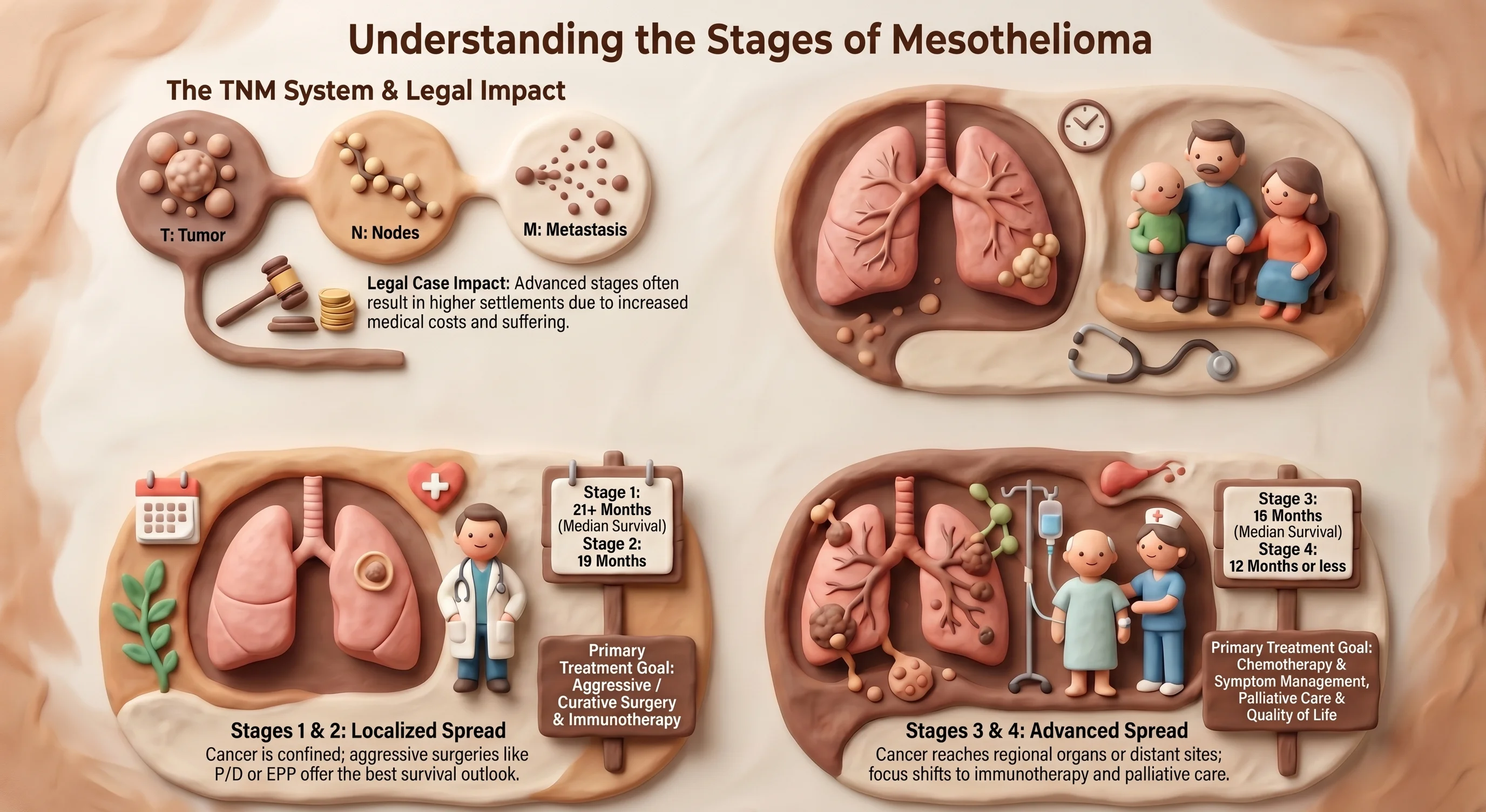
Staging is the process doctors use to determine how far a cancer has spread in the body. For mesothelioma, staging is critical because it guides treatment decisions and provides patients and their families with a better understanding of what to expect. The standard staging system for pleural mesothelioma (the most common type) is the TNM system, which evaluates three factors:
- T (Tumor): The size and extent of the primary tumor
- N (Nodes): Whether cancer has spread to nearby lymph nodes
- M (Metastasis): Whether cancer has spread to distant organs
Based on these factors, mesothelioma is assigned a stage from 1 to 4, with stage 1 being the most localized and stage 4 the most advanced. Peritoneal, pericardial, and testicular mesothelioma do not have their own formal staging systems but are described using similar descriptive criteria.
Stage 1 Mesothelioma: Localized
In stage 1, the cancer is confined to one side of the pleura (the lining of the lungs) and has not spread to lymph nodes or distant organs. The tumor is still localized to the area where it first developed.
Symptoms at stage 1 are often minimal or absent, which is one reason so few patients are diagnosed at this early stage. Some patients may notice mild shortness of breath or slight discomfort in the chest, which can easily be mistaken for other conditions.
Treatment options at stage 1 are the most aggressive and potentially curative. Surgery — either pleurectomy/decortication (P/D) or extrapleural pneumonectomy (EPP) — may be performed to remove as much of the tumor as possible. This can be combined with chemotherapy and radiation (trimodality therapy) for the best possible outcome.
Prognosis: Stage 1 mesothelioma carries the best survival outlook, with median survival of 21 months or longer. Some stage 1 patients at specialized mesothelioma centers have achieved survival of several years or more.
Stage 2 Mesothelioma: Limited Spread
At stage 2, the cancer has spread beyond the original site into nearby tissue — possibly extending into the lung itself, the diaphragm, or adjacent lymph nodes. However, the cancer is still primarily confined to one side of the chest.
Symptoms at stage 2 are more pronounced than in stage 1 and may include noticeable shortness of breath, mild chest pain, fatigue, and a persistent dry cough. Some patients begin losing weight without trying.
Treatment options at stage 2 still include surgery for eligible patients, though the cancer's spread to nearby tissue makes complete removal more challenging. Chemotherapy and immunotherapy are also commonly used.
Prognosis: Median survival for stage 2 mesothelioma is approximately 19 months with treatment.
Stage 3 Mesothelioma: Regional Spread
Stage 3 mesothelioma has spread more extensively — into nearby organs such as the pericardium (heart lining), chest wall, or diaphragm, and typically into regional lymph nodes. Most mesothelioma patients in the United States are diagnosed at stage 3.
Symptoms at stage 3 are typically significant and affect daily life. Patients often experience severe shortness of breath, significant chest pain, pleural effusion (fluid around the lungs), fatigue, and noticeable weight loss. These symptoms are often what finally prompt a patient to seek medical attention.
Treatment options at stage 3 depend on the extent of spread. Surgery may still be possible in some cases, but many patients at this stage are not surgical candidates. Chemotherapy (pemetrexed plus cisplatin or carboplatin) remains the standard treatment, and immunotherapy (particularly nivolumab plus ipilimumab) has shown promising results in clinical trials.
Prognosis: Median survival for stage 3 mesothelioma is approximately 16 months with treatment.
Diagnosed at Any Stage? You May Be Entitled to Compensation
Mesothelioma at any stage qualifies for legal compensation. More advanced cases often result in higher settlements. Contact an attorney now — statutes of limitations apply.
Find an Attorney in Your StateStage 4 Mesothelioma: Advanced Disease
Stage 4 is the most advanced stage of mesothelioma. The cancer has spread to distant organs — possibly the liver, kidney, other lung, bones, or brain. At this stage, surgery is no longer feasible, and treatment focuses primarily on managing symptoms and extending quality of life.
Symptoms at stage 4 are often severe and debilitating: extreme fatigue, significant weight loss, severe pain, difficulty swallowing, neurological symptoms (if the cancer has spread to the nervous system), and greatly compromised breathing function.
Treatment at stage 4 typically includes chemotherapy to slow progression, immunotherapy in eligible patients, palliative radiation to shrink painful tumors, drainage of pleural effusions to relieve breathing difficulty, and comprehensive palliative and hospice care.
Prognosis: Median survival for stage 4 mesothelioma is typically 12 months or less from diagnosis, though some patients respond well to immunotherapy and live significantly longer. Clinical trials at major cancer centers may offer additional options.
How Staging Affects Your Legal Case
The stage of your mesothelioma diagnosis is relevant to your legal case in several important ways. More advanced stages generally result in higher settlement amounts because they reflect:
- Greater past, current, and future medical expenses
- More significant loss of income and earning capacity
- Greater pain, suffering, and diminished quality of life
- Shorter life expectancy (relevant to wrongful death cases)
However, it is important to understand that you can pursue legal compensation at any stage of mesothelioma — including at stage 1 or 2. In fact, acting early is beneficial because it gives you more time to gather evidence, identify responsible parties, and participate actively in the legal process. Many attorneys can even file emergency or expedited proceedings for patients with advanced disease. Learn how to choose a mesothelioma attorney →
Frequently Asked Questions
Mesothelioma is staged 1 through 4. Stage 1 is localized and most treatable. Stage 2 involves nearby tissue spread. Stage 3 has spread to nearby organs and lymph nodes. Stage 4 is the most advanced, with cancer spread to distant organs or throughout the body.
Most mesothelioma patients are diagnosed at stage 3 or stage 4 because the disease's symptoms often don't appear until the cancer has been growing for years. Early-stage diagnosis is relatively rare but results in significantly better treatment outcomes.
Stage 4 mesothelioma cannot typically be cured, but it can be treated to manage symptoms, slow progression, and improve quality of life. Chemotherapy, immunotherapy, and palliative care are the most common approaches at this stage.
Yes. More advanced stages typically result in larger settlements and verdicts because they reflect greater suffering, higher medical costs, and shorter life expectancy. However, you can pursue compensation at any stage of mesothelioma.
Stage 1: median survival 21+ months. Stage 2: approximately 19 months. Stage 3: approximately 16 months. Stage 4: approximately 12 months or less. Individual outcomes vary significantly based on cell type, treatment, and overall health.