What Is Mesothelioma? Causes, Latency Period & Symptoms
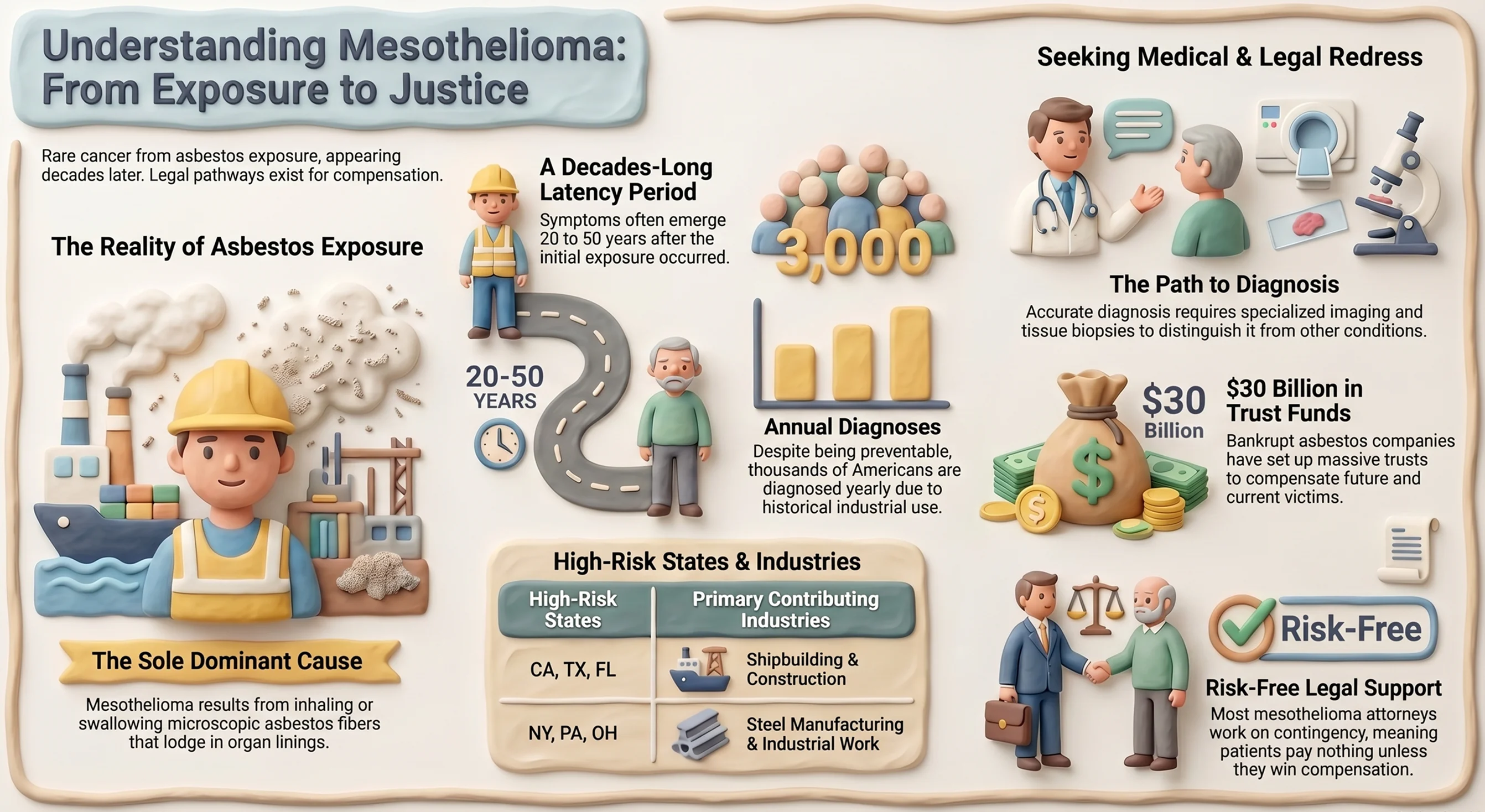
- Mesothelioma is a rare, aggressive cancer caused almost exclusively by asbestos exposure
- The disease has a long latency period — symptoms may not appear for 20 to 50 years after exposure
- Roughly 3,000 new cases are diagnosed in the United States every year
- Veterans, shipyard workers, construction workers, and industrial employees face the highest risk
- Victims may be eligible for significant financial compensation through lawsuits and trust fund claims
Understanding Mesothelioma
Mesothelioma is a rare and serious cancer that affects the mesothelium — the thin protective lining that surrounds most of the body's internal organs. The mesothelium covers the lungs (pleura), the abdomen (peritoneum), the heart (pericardium), and the testes. When cancer develops in these tissues, it is called mesothelioma.
Unlike most cancers, mesothelioma has one dominant, well-established cause: exposure to asbestos. Asbestos is a group of naturally occurring minerals made up of microscopic fibers that were widely used in construction, manufacturing, shipbuilding, and many other industries throughout the 20th century. When asbestos-containing materials are disturbed, tiny fibers are released into the air. These fibers can be inhaled or swallowed, and once inside the body, they can become permanently lodged in the lining of the lungs or abdomen.
Over time — often many decades — these embedded fibers cause chronic inflammation and cellular changes that lead to cancerous tumors. The long gap between asbestos exposure and the development of mesothelioma means many patients are diagnosed in their 60s, 70s, or even 80s, long after their working years are over.
How Common Is Mesothelioma?
Approximately 3,000 Americans are diagnosed with mesothelioma each year, according to the American Cancer Society. While this number is relatively small compared to other cancers, the disease is notable for its severity and the fact that it is almost entirely preventable — it results almost exclusively from man-made exposure to a hazardous substance that was used widely despite industry knowledge of its dangers.
The United States has one of the highest rates of mesothelioma in the world due to its heavy industrial use of asbestos throughout the mid-20th century. States with the most cases include California, Texas, Florida, New York, Pennsylvania, and Ohio — all states with significant shipbuilding, steel manufacturing, and construction industries.
Men are affected at a much higher rate than women because most occupational asbestos exposure occurred in male-dominated industries. However, women who were exposed through a spouse or family member who brought asbestos fibers home on their work clothes — a phenomenon known as "secondary" or "take-home" exposure — have also developed mesothelioma.
Symptoms of Mesothelioma
One of the most challenging aspects of mesothelioma is that its symptoms are often vague and easily confused with other, less serious conditions. This means many patients are not diagnosed until the disease has reached an advanced stage.
Pleural mesothelioma (affecting the lining of the lungs) is the most common form and typically causes:
- Shortness of breath, especially when lying down
- Persistent chest pain or pain in the lower back or side
- A chronic dry or raspy cough
- Fluid buildup around the lungs (pleural effusion)
- Difficulty swallowing
- Unexplained weight loss
- Fatigue and general weakness
Peritoneal mesothelioma (affecting the abdominal lining) typically causes:
- Abdominal pain or swelling
- Nausea and vomiting
- Changes in bowel habits
- Lumps of tissue in the abdomen
- Weight loss
Because these symptoms often appear gradually and mimic other common conditions like pneumonia or irritable bowel syndrome, getting an accurate diagnosis requires specific tests and a physician experienced with mesothelioma.
Speak with a Mesothelioma Attorney Today
A diagnosis of mesothelioma may entitle you to significant financial compensation. Most attorneys work on contingency — you pay nothing unless they win your case.
Find an Attorney in Your StateDiagnosing Mesothelioma
Diagnosing mesothelioma typically involves several steps. Because the disease is rare, it is important to see a physician who has experience with asbestos-related diseases. The diagnostic process generally includes:
Medical history and physical exam: Your doctor will ask about your work history, any known asbestos exposure, and the duration and intensity of symptoms. This history is critical because it helps establish the link to asbestos.
Imaging tests: Chest X-rays, CT scans, and MRIs can reveal pleural thickening, fluid accumulation, and masses that may suggest mesothelioma.
Biopsy: A tissue sample is required to confirm a mesothelioma diagnosis. This may involve a needle biopsy, thoracoscopy (for pleural mesothelioma), or laparoscopy (for peritoneal mesothelioma).
Pathology analysis: The tissue sample is examined by a pathologist. Because mesothelioma cells can resemble other types of cancer, specialized staining techniques and sometimes a second opinion from a mesothelioma specialist are recommended.
Cell Types of Mesothelioma: How They Affect Treatment and Prognosis
Mesothelioma is classified not only by location but by the appearance of cancer cells under a microscope. Cell type is one of the strongest predictors of how a patient responds to treatment.
Epithelioid mesothelioma is the most common cell type, accounting for roughly 50–70% of all diagnoses. Epithelioid cells are well-organized and tend to grow more slowly than other types. Patients with epithelioid mesothelioma generally have better treatment outcomes and longer median survival times — often 18 to 24 months or more with aggressive treatment.
Sarcomatoid mesothelioma is the least common and most aggressive cell type, representing about 10–20% of cases. These cells are disorganized and spindle-shaped, making them harder to identify and treat. Sarcomatoid mesothelioma is less responsive to standard chemotherapy, and median survival is often under 12 months from diagnosis.
Biphasic mesothelioma contains a mixture of both epithelioid and sarcomatoid cells. It accounts for approximately 20–35% of cases. Prognosis depends on which cell type predominates — a higher proportion of epithelioid cells is associated with better outcomes.
Desmoplastic mesothelioma is a rare subtype of sarcomatoid mesothelioma, accounting for less than 5% of cases. It is characterized by dense fibrous tissue that makes it particularly difficult to distinguish from benign (non-cancerous) conditions. This diagnostic challenge can cause dangerous delays in treatment.
Understanding your cell type is critical because it affects your treatment options. For example, some immunotherapy drugs work better for epithelioid types. Your attorney should also be aware of your cell type, as it affects the medical evidence supporting your legal case.
Who Is Most at Risk for Mesothelioma?
While any asbestos exposure can theoretically cause mesothelioma, certain populations face dramatically elevated risk. Understanding who is most vulnerable helps identify both medical and legal pathways.
High-Risk Occupations
The following occupations account for the majority of mesothelioma diagnoses in the United States:
| Occupation | Primary Exposure Source | Risk Level |
|---|---|---|
| Insulation workers | Pipe and equipment insulation | Highest |
| Shipyard workers | Asbestos insulation throughout vessels | Extreme |
| Navy veterans | Ships, boiler rooms, engine rooms | Extreme |
| Construction workers | Roofing, flooring, joint compound, tiles | Very High |
| Pipefitters and plumbers | Pipe insulation and gaskets | Very High |
| Boilermakers | Boiler insulation, gaskets, valves | Very High |
| Auto mechanics | Brake pads, clutches, gaskets | High |
| Railroad workers | Locomotive insulation, brake shoes | High |
Veterans, especially those who served in the Navy, represent approximately 30% of all mesothelioma diagnoses in the United States. This disproportionate rate reflects the extensive use of asbestos in all areas of naval vessels — boiler rooms, engine rooms, sleeping quarters, and throughout the ship's pipe insulation systems.
Demographics and Age at Diagnosis
Because of mesothelioma's long latency period, most patients are diagnosed between the ages of 65 and 74. Men are diagnosed at rates approximately four to five times higher than women, reflecting the historically male-dominated nature of the industrial occupations most associated with asbestos exposure. However, women who experienced secondary (take-home) asbestos exposure — often through a spouse or family member who worked with asbestos — have also developed the disease.
There is no known "safe" level of asbestos exposure. Even brief or low-level exposure has been documented as a cause of mesothelioma in some individuals, though higher and longer exposure is generally associated with greater risk.
Asbestos and Corporate Negligence: What the Evidence Shows
One of the most important facts in any mesothelioma legal case is that asbestos manufacturers and distributors were aware of the health dangers of asbestos for decades before they were required to disclose them or stop using the material.
Internal industry documents — many of which have been made public through mesothelioma litigation — show that companies including Johns-Manville, W.R. Grace, Armstrong World Industries, and dozens of others:
- Knew as early as the 1930s and 1940s that asbestos caused fatal lung disease
- Funded and then suppressed their own scientific studies showing asbestos dangers
- Continued to manufacture and market asbestos products without warning labels for decades
- Lobbied against safety regulations that would have protected workers
- Funded industry groups that publicly disputed the link between asbestos and disease
This documented concealment is why mesothelioma cases often result in large jury verdicts — courts and juries alike recognize that these companies' behavior was not merely negligent, but in many cases deliberately deceptive. More than 60 of these companies eventually went bankrupt under the weight of mesothelioma litigation and were required by courts to establish trust funds to compensate future victims. These trust funds, collectively holding over $30 billion, remain accessible to eligible claimants today.
Treatment Options for Mesothelioma
Mesothelioma is a serious illness, but treatment options have expanded significantly in recent years. The appropriate treatment depends on the type of mesothelioma, its stage at diagnosis, the patient's cell type, and overall health status.
Surgery
Surgical options are typically reserved for early-stage mesothelioma patients who are otherwise in good health. The two main surgical procedures for pleural mesothelioma are:
Extrapleural pneumonectomy (EPP): Removal of the affected lung, the pleura, the pericardium, and portions of the diaphragm. This is the most radical surgical option and is reserved for patients in excellent overall health at early stages. It carries significant risks but can substantially extend survival in carefully selected patients.
Pleurectomy/decortication (P/D): Removal of the pleura (the lining) while preserving the lung itself. This approach is less aggressive than EPP and is increasingly preferred at major mesothelioma centers because it can achieve similar results with fewer complications. It can also be performed at later stages than EPP.
For peritoneal mesothelioma, cytoreductive surgery combined with hyperthermic intraperitoneal chemotherapy (HIPEC) has produced some of the most promising survival results of any mesothelioma treatment — with some patients surviving five years or more after diagnosis.
Chemotherapy
Chemotherapy remains the standard first-line treatment for most mesothelioma patients who are not candidates for surgery. The combination of pemetrexed (Alimta) and cisplatin has been the standard-of-care regimen for pleural mesothelioma since 2004. Carboplatin is often substituted for cisplatin in patients who cannot tolerate its side effects. Response rates to first-line chemotherapy average 40–45%, and chemotherapy can significantly slow disease progression and improve quality of life.
Immunotherapy
Immunotherapy has emerged as one of the most exciting developments in mesothelioma treatment. In 2020, the FDA approved nivolumab (Opdivo) combined with ipilimumab (Yervoy) as a first-line treatment for unresectable pleural mesothelioma. Clinical trials showed that this combination improved overall survival compared to chemotherapy alone, with some patients experiencing durable long-term responses.
Immunotherapy works by helping the patient's own immune system recognize and attack cancer cells. It is not appropriate for all patients, and responses vary considerably, but it represents a significant advancement in the treatment landscape for mesothelioma.
Radiation Therapy
Radiation therapy plays a supporting role in mesothelioma treatment. It is most often used after surgery to eliminate residual cancer cells or as palliative therapy to reduce pain from tumor growth. Because the pleura is so close to critical structures — the lungs, heart, and spinal cord — radiation therapy for mesothelioma requires advanced techniques such as intensity-modulated radiation therapy (IMRT) to minimize damage to healthy tissue.
Clinical Trials
Mesothelioma clinical trials are testing promising new approaches including novel immunotherapy combinations, targeted therapies, gene therapy, and tumor-treating fields (TTFields). Major mesothelioma specialty centers — including MD Anderson, Memorial Sloan Kettering, and Brigham and Women's Hospital — have active clinical trial programs. Patients who participate in trials sometimes have access to cutting-edge treatments years before they receive FDA approval.
Prognosis and Survival Rates
Mesothelioma prognosis has historically been poor, but outcomes are improving as treatment options expand. The following statistics reflect median survival — meaning half of patients survive longer than this period, and half do not. Individual outcomes vary considerably based on stage, cell type, treatment, and overall health.
| Stage | Median Survival | Treatment Options |
|---|---|---|
| Stage 1 | 21+ months | Surgery + chemo, clinical trials |
| Stage 2 | ~19 months | Surgery (selected), chemo, immunotherapy |
| Stage 3 | ~16 months | Chemo, immunotherapy, palliative surgery |
| Stage 4 | ~12 months | Chemo, immunotherapy, palliative care |
It is important to note that these are population-level statistics, not individual predictions. Some patients with stage 4 mesothelioma survive several years with aggressive treatment, particularly those with epithelioid cell type receiving immunotherapy. Conversely, some early-stage patients with aggressive sarcomatoid tumors may have shorter survival despite treatment.
Peritoneal mesothelioma treated with cytoreductive surgery and HIPEC has shown some of the most encouraging survival data: studies from major cancer centers have reported five-year survival rates of 35–50% for carefully selected patients.
What to Do After a Mesothelioma Diagnosis: The First 30 Days
The first 30 days after a mesothelioma diagnosis are critical — both medically and legally. Here is a practical roadmap:
Get a second opinion from a mesothelioma specialist. Mesothelioma is rare and complex. A second opinion from a physician who sees many mesothelioma cases per year can confirm the diagnosis, identify the cell type accurately, and open doors to surgical or clinical trial options that a general oncologist may not be aware of. This is not about doubting your doctor — it is standard practice for rare and serious cancers.
Document your work history in detail. Write down every employer you've worked for, every job site you've visited, and any products you remember working with or around that might have contained asbestos. Include the years, locations, and names of coworkers if possible. This information is essential for your medical care and your legal case.
Consult a mesothelioma attorney immediately. Statutes of limitations — the legal deadlines for filing a lawsuit — typically give you only 1 to 4 years from your diagnosis date or from a loved one's death, depending on your state. Acting quickly preserves your legal rights. Most mesothelioma attorneys offer free consultations and work on contingency — no fees unless they win.
Contact the VA if you are a veteran. Veterans are eligible for VA disability compensation and VA healthcare for mesothelioma, separate from any private legal claims. These benefits can provide significant financial support for treatment and family care during your illness.
Gather your medical records. Collect records of your diagnosis, pathology report, imaging studies, and treatment plans. These will be needed by your attorney and by any specialists you consult.
Your Legal Rights After a Mesothelioma Diagnosis
If you or a loved one has been diagnosed with mesothelioma, it is important to understand that you may have legal rights to financial compensation. The companies that manufactured, distributed, and installed asbestos-containing products knew for decades that asbestos was dangerous. Despite this knowledge, they continued to sell and use these products, putting millions of workers and their families at risk.
There are several legal avenues available to mesothelioma victims and their families:
Personal injury lawsuits: If you are alive and diagnosed with mesothelioma, you can file a personal injury lawsuit against the companies responsible for your asbestos exposure. These lawsuits can result in settlements or jury verdicts that compensate you for medical expenses, lost income, pain and suffering, and other damages.
Wrongful death lawsuits: If a family member has died from mesothelioma, surviving family members may file a wrongful death lawsuit seeking compensation for their loss.
Asbestos trust fund claims: Many asbestos companies went bankrupt under the weight of litigation and were required to establish trust funds to compensate future victims. More than 60 asbestos bankruptcy trusts hold over $30 billion in combined assets. Filing a trust fund claim is separate from a lawsuit and can often be done more quickly. Learn more about trust fund claims →
VA benefits for veterans: Military veterans who were exposed to asbestos during their service may be eligible for VA disability benefits and VA healthcare in addition to pursuing legal claims. Learn more about veterans' options →
Most mesothelioma attorneys work on a contingency fee basis, meaning you pay no upfront fees and no legal costs unless your attorney wins compensation for you. This arrangement makes it possible for anyone — regardless of financial situation — to pursue justice.
Frequently Asked Questions
Mesothelioma is a rare and aggressive cancer that develops in the mesothelium — the thin layer of tissue that covers most internal organs. It is almost exclusively caused by exposure to asbestos fibers.
The primary cause of mesothelioma is exposure to asbestos. When asbestos fibers are inhaled or swallowed, they can become lodged in the mesothelium and cause cellular damage that eventually leads to cancer, typically 20–50 years after exposure.
Common symptoms include shortness of breath, chest pain, persistent cough, fluid buildup around the lungs or abdomen, fatigue, and unexplained weight loss. Symptoms often don't appear until the disease has progressed to a later stage.
The latency period for mesothelioma is typically 20 to 50 years. This means many people aren't diagnosed until decades after their original asbestos exposure, often not until retirement age or later.
Yes. If you have been diagnosed with mesothelioma and were exposed to asbestos at work, in the military, or through a family member's work clothes, you may be eligible to file a personal injury lawsuit or asbestos trust fund claim. Most attorneys handle these cases on contingency — no fee unless they win your case.